



Efficient Management of CCM Contracts in SAP S/4 HANA
With the CCM module in SAP S/4 HANA, SAP has created an extremely powerful tool for the retroactive settlement of conditions in both procurement and sales. Using condition contracts that can be configured entirely through customizing—without any custom programming—the foundation is laid for automated settlement and posting within the SAP system.
The contracts themselves are typically tightly embedded in company-specific business processes and are therefore designed in a highly individual manner. As a result, the control and monitoring of the achieved results must inevitably be aligned with these processes as well.
At this point, however, the SAP standard often reaches its limits. The analyses provided by SAP offer only limited support for the targeted management of CCM contracts. While the SAP Fiori analytics fundamentally address the capabilities of modern web technologies, they do not fully leverage this potential.
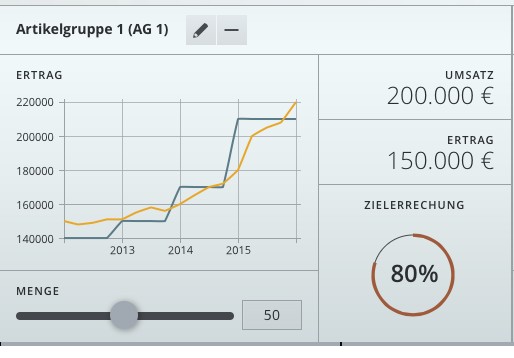
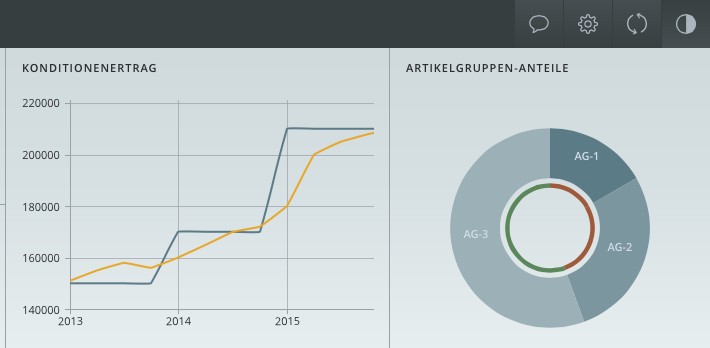
For this reason, together with our cooperation partners, we have developed an alternative approach over the past few years: web-based, custom-tailored dashboards for the SAP CCM environment. These dashboards offer several decisive advantages. They are significantly more cost-effective to implement than adaptations or extensions of standard SAP Fiori apps. For efficient analysis, threshold-based evaluations are used, which—especially with large data volumes—display only truly relevant information instead of presenting millions of irrelevant individual records, as is often the case with traditional ABAP-based reports.
In addition to trend analyses and simulations, the dashboards also enable the comparison of CCM data with information from other SAP modules, such as procurement or sales. This creates a holistic view of the underlying business relationships. The data foundation always remains the original SAP system. Access is provided without developing additional ABAP programs, instead using a proprietary functional technology. This makes the solution not only transparent, but also particularly low-maintenance.
Another advantage becomes apparent when company-specific business cases change. If condition contracts are modified or new contracts are introduced, the corresponding control mechanisms can be adjusted quickly and cost-effectively. A practical example is the analysis of condition revenues. Using threshold-based analysis, the dashboard displays only those items or assemblies that deviate significantly from the planned condition revenues. It deliberately does not show all settled line items. In addition, relevant information from other SAP modules—such as sales figures from Sales, prior-year values, or other key performance indicators—is integrated. This not only makes deviations visible, but also directly supports root-cause analysis.
Conclusion:
Today, it is possible to establish efficient and cost-effective control instruments for the SAP CCM module. Web-based dashboards built on modern technologies provide significantly greater transparency, support well-founded decision-making, and systematically unlock the economic potential of CCM contracts in a sustainable way.